North CarolinaFleet Washing Desk

North Carolina Fleet Washing Desk · Updated 2026-10-17

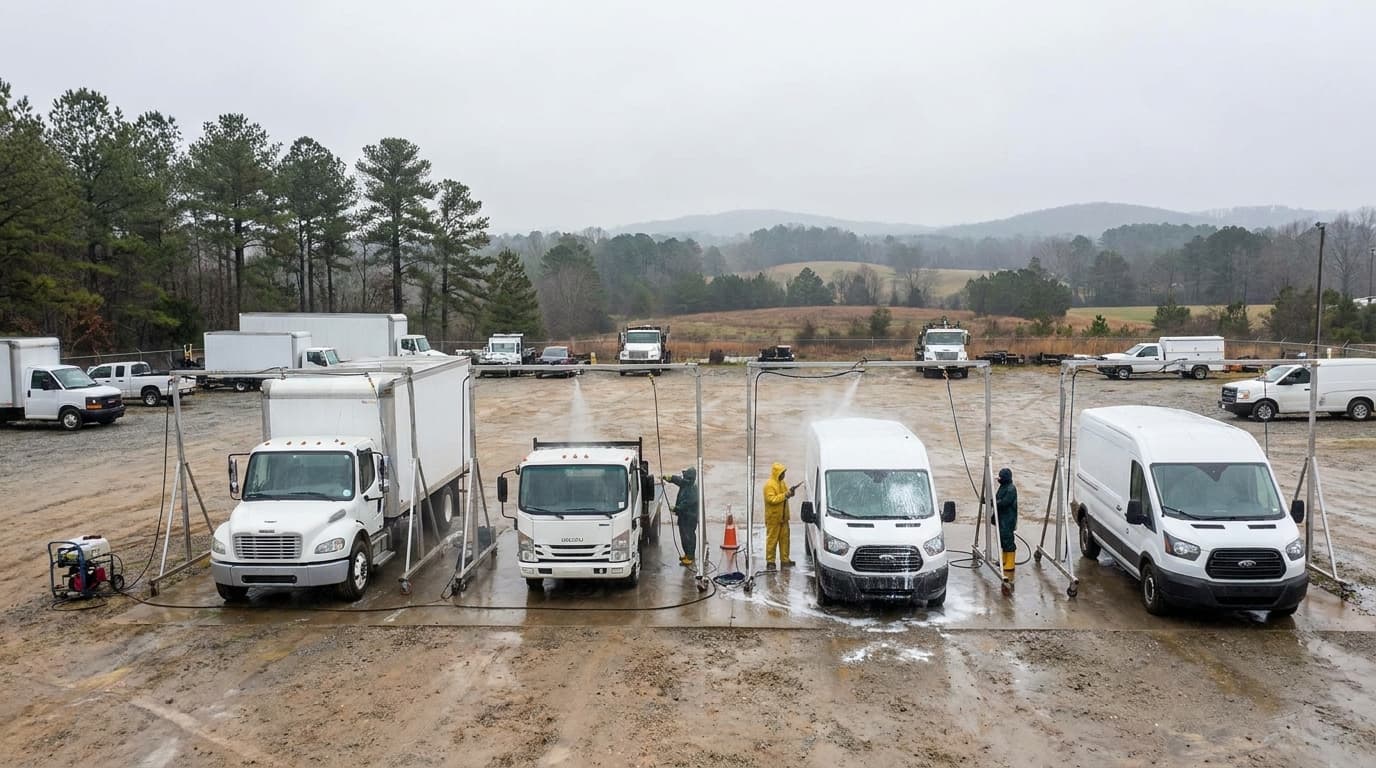
A worker in an orange safety vest pressure-washes the side of a white box truck beside a mobile wash rig with a white tank and a hose reel on a gravel lot.

Fleet washing in North Carolina

You can ask here for a mobile wash of a work fleet at a North Carolina yard.

North Carolina Fleet Washing Desk receives the request and replies by email.

A single passenger car, a home driveway, or a drive-through wash stops the form.

What you send from this page

You already have trucks, vans, or trailers that need a wash where they park. The form takes a phone number and an email. That is the request.

The request stays with North Carolina Fleet Washing Desk until one company that does this job is named. A company is not promised to call you back.

What was not measured

A statewide wash price, a water test, and a time until a truck is clean are not on this page. If a figure is not in the quoted line on a county page, that page leaves the sentence out.
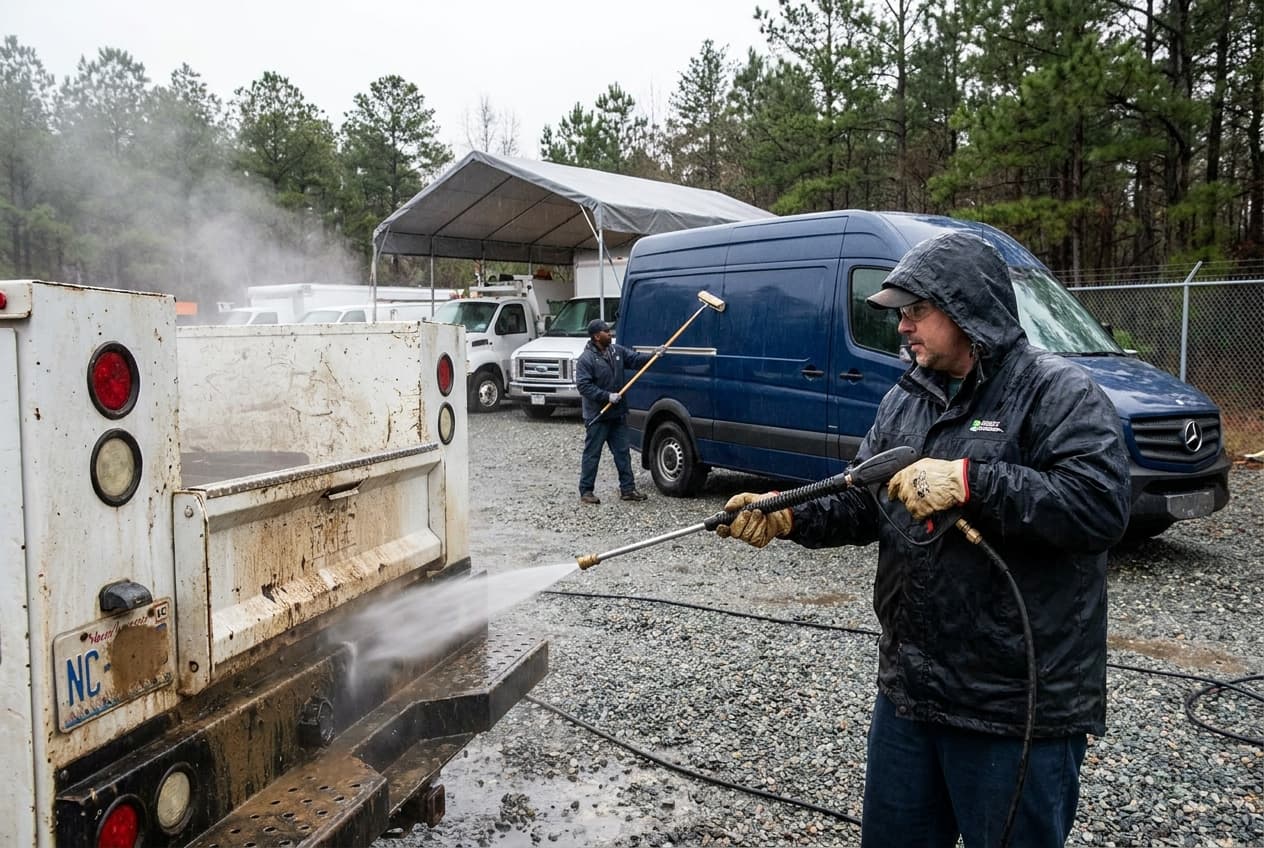
A worker in a blue shirt and an orange vest holds a pressure-washer wand against the lower rear of a dirty white box truck, with a fan of water on the panel above the rear wheels.

Places with a quoted page

Counties lists those same pages. The job itself is on the rule.

Wastewater recapture and noise, by county

A mobile car wash is deemed permitted under 15A NCAC 02T .0113 only when every detergent is biodegradable, no steam cleaning, engine cleaning, or parts cleaning is underway, the owner notifies the municipality before operating (or the county, if the site is not in a municipality), and non-recyclable washwater is collected and discharged to a sanitary sewer or wastewater treatment facility with that facility owner's approval, with no ponding and no runoff.

NC DEQ vehicle-washing guidance says pressure-washing wash water is a wastewater, and no NPDES stormwater permit authorizes a discharge of that water to surface waters through a storm drain. The rows below are the local lines copied for the counties this site covers. A figure that is not in those lines is left out.

Wastewater recapture and noise rules for Mecklenburg, Wake, Guilford, Cumberland, Forsyth, and Buncombe. Each cell names the page it was copied from.
CountyWastewater recaptureNoise ordinance
MecklenburgThe Charlotte-Mecklenburg illicit-discharge manual says storm water is the only discharge permitted in the stormwater system or the waters of the State, except listed incidental discharges that do not negatively impact surface water quality. Single-family residential and charity vehicle washing is on that list. Discharge from a commercial car wash is not. The manual's enforcement examples list a commercial car-wash discharge as a Class II violation. The state conditions above still apply.The City of Charlotte noise page says this ordinance is enforced inside Charlotte city limits. Construction machinery is not allowed between 9 p.m. and 7 a.m., except when city crews or city contractors must work then to keep the public safe or to avoid a break in transportation or a public utility. The same page restricts power-tool hours from 9 p.m. to 7 a.m. It does not print a pressure-washer decibel cap.
WakeNo separate Wake County recapture ordinance was copied. A mobile wash in Wake still has to meet the state conditions above, including notice to the municipality or, outside a municipality, to the county.Wake County Chapter 92 applies to noise that starts in unincorporated Wake County. It does not apply inside town limits, and it does not set a decibel cap for Research Triangle Park. Unreasonable noise is unlawful. Daytime is 7:00 a.m. to 11:00 p.m. Nighttime is 11:00 p.m. to 7:00 a.m. When the Unified Development Ordinance site performance standards apply, those non-residential uses are not subject to Chapter 92.
GuilfordNo separate Guilford County recapture ordinance was copied. A mobile wash in Guilford still has to meet the state conditions above.The Greensboro code compilation, section 18-50, says a compressed-air device is unlawful unless the noise is effectively muffled and reduced. Building operations, including excavation and grading, are unlawful in a residential district from 6:00 p.m. to 7:00 a.m., and in any other district from 10:00 p.m. to 7:00 a.m. That compilation is the city code, not a countywide decibel cap.
CumberlandNo separate Cumberland County recapture ordinance was copied. A mobile wash in Cumberland still has to meet the state conditions above.Cumberland County Code § 9.5-24 measures sound at or beyond the property line. The level may not exceed Table 1 for more than five minutes, or for more than ten percent of readings taken every five seconds across at least ten minutes. Residential or public space is 60 dB(A) from 6 a.m. to 10 p.m. and 55 dB(A) from 10 p.m. to 6 a.m. Commercial or business is 65 dB(A) and 60 dB(A) on those same clocks. Manufacturing, industrial, or agricultural is 75 dB(A) at all times.
ForsythThe Winston-Salem water and sewer excerpt bars trucked or hauled pollutants except at discharge points the director designates under Section 56. It also bars noxious or malodorous wastewater that is sufficient to create a public nuisance or a hazard to life. The state conditions above still apply.Winston-Salem section 46-5 makes garage machinery, and gasoline-powered domestic tools used outdoors, unlawful from 10:00 p.m. to 6:00 a.m. in a residentially zoned area or within 300 feet of a residence. The section does not apply when the sound is not plainly audible at the neighboring premises, or to emergency work that protects public health and safety.
BuncombeNo separate Buncombe County recapture ordinance was copied. A mobile wash in Buncombe still has to meet the state conditions above.Asheville section 10-83 sets sound limits for noise that starts inside the city, measured where the sound is received. From an industrial district the limits are 70 dB(A) from 7:00 a.m. to 10:00 p.m. and 65 dB(A) from 10:00 p.m. to 7:00 a.m. From a commercial district they are 65 dB(A) and 57 dB(A). A pure tone, a continuous sound, a cyclically varying sound, or a repetitive impulsive sound is reduced by another five decibels. Section 10-87 is a construction-permit rule, not a county wash rule.